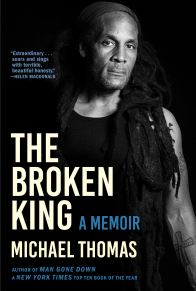
“A prize-winning writer’s anguish . . . Thomas believes that one way to keep “from falling into darkness” is to try “to make something beautiful.” This book hits the mark . . . A powerful memoir of childhood trauma, literary success, and mental illness.”—Kirkus Reviews (starred review)
“Michael Thomas has written a truly extraordinary memoir, one that sears and sings with such terrible, beautiful honesty it will burn its way deep into your bones. The Broken King is a book for now, but feels like it’s always been part of the world in the way only great literature does. This hardscrabble lyric masterpiece is funny and brutal, soaring and chthonic. A triumph, and reading it will leave you changed. It’s genuinely one of the most extraordinary and magical books I have ever read. I’m full of awe.”—Helen Macdonald, New York Times bestselling author of H Is for Hawk
“Lord knows, Michael Thomas has paid some dues. He writes on the perils of being Black in America; the sorrows of damaged family; struggles with a self-destructive and treacherous self; of love, work, and ambition; of a mixed-race marriage and of fatherhood with its wondrous mysteries, terrors, joys. There’s a bridge of beautiful American prose—lyrical, powerful, fearlessly candid—running straight from James Baldwin to Thomas, who is obviously Baldwin’s worthy heir. But The Broken King also harkens back to Melville, Emerson, and spans our own time too, as if in transatlantic conversation with Knausgaard. Like all those titans, Thomas writes about the struggle to be a man, and, simply and most complexly, on how to live. An utterly immersive book.”—Francisco Goldman, author of Pulitzer Prize finalist Monkey Boy
Praise for Man Gone Down:
“Powerful and moving . . . An impressive success . . . [Thomas] knows how the odds are stacked in America. He knows the unlikelihood of successful black fatherhood. He knows that things are set up to keep the Other poor and the poor in their place. More than anything else, he knows how little but also—fortunately—how much it can take to bring a man down.” —Kaiama L. Glover, New York Times Book Review in a front page review
“[A] jazzy, sinewy debut . . . Thomas’s urgent, quicksilver prose makes even the darkest moments of this novel shine.” —Cathleen Medwich, O: The Oprah Magazine
“A ravishing blues for the soul’s unending loneliness.” —Donna Seaman, Booklist (starred review)
“The narrator’s hard-bitten realism and Thomas’s blues-dirge-y storytelling instincts keep the narrative thrumming.” —Jonathan Durbin, People
“Ambitious . . . The book is filled with some virtuoso passages that expose the subtle degrees of racism in the narrator’s world.” —Kirkus Reviews
“What a novel, and what a writer. Michael Thomas is brilliant, and Man Gone Down is riveting. Every page vibrates with love and anger and hope.” —Elizabeth Gaffney, author of Metropolis
“Thomas’s knack for bonding the reader with a number of New York characters is admirable, and the narrator’s thoughts about his marriage, work and racial tension are as graceful as they are blunt . . . Thomas’s subtle prose casts a new light on urban life in Brooklyn––even if you already live there.” —Cherie Dennis, Time Out New York
“Like the characters of Ralph Ellison, James Baldwin and Lorraine Hansberry, whom [Thomas] references throughout the novel with recognizable phrases, themes and quotes, [the] unnamed narrator is a black man concerned with identity in a decidedly white America . . . Thomas imbues the story with an intense pace and urgency as he explores masculinity, humanity and where the narrator – a self-proclaimed ‘social experiment’ – fits in . . . In the end, the novel itself is rather like its main character: a brilliant and frustrating social experiment that is still quite worthy of our attention.” —Tina McElroy Ansa, Washington Post
“A real uncertainty haunts Man Gone Down and its landscapes, sticking to their edges. It captures human flux.” —Tess Taylor, San Francisco Chronicle
“Michael Thomas’ Man Gone Down moves along nicely. His unnamed narrator is broke, estranged from his wife and children and temporarily living in a friend’s child’s room, while desperately trying to figure out his life. This debut has racism at its core, but there’s much more to it than that.”—Martin Zimmerman, San Diego Union Tribune


 Grove Press
 NEW!
NEW!